Wednesday, 18 December 2013

Loving carbs...

Luke and I recently held another Vivid Fitness Seminar where the topic was Sugars & Carbs. It amazed me that when we asked the question to the people in attendance who ate carbs before bed no one raised their hand. What was more amazing was, when asked, no-one seemed to know the reason behind why they were so worried about eating carbs at night. I am sure most of the people in the room were worried about eating carbs at all.

My favourite pre-bed meal

I see it time and time again with clients and friends; they want to lose weight so the first thing they do is cut back the carbs. I am sure if I asked them why they cut out a whole macro-nutrient group they would be unable to give me an answer.

Don't get me wrong, why wouldn't people think that carbs are the enemy with so many low carb, zero carb and carb cutting diets out in the market place. Marketing makes us all believe that to drop weight you need to drop the carbs. I was also one of the believers for a long time and it was the carb cutting/reducing that saw my weight yo-yo until I saw the light....now I am a carb fiend! Even more so now I am pregnant; I need those delicious, energy giving, yummy tasting carbs to grow a healthy baby. So if my baby needs these carbs and it is what I need to grow said baby why would I have ever allowed myself to be sucked in to believing that they are bad for me?

I am going to let you in on what I have learnt, over the years, about carbs. I am not going to talk about losing "weight" but I am going to explain why you need carbs to build a strong, lean, fat-burning furnace!!

Fact number one... Glucose {sugar} and carbohydrates are the same thing!! Our body's digestive system breaks down carbs in to glucose and it is glucose that is our body's preferred source of fuel. When we consume carbs our pancreas secretes Insulin. It is the Insulin's job to transport the glucose from our bloodstream in to every cell in our body to be used for energy. Our brain, muscles and central nervous system all rely on glucose as their main source of fuel which is why it is so important that we consume the right quantities of good quality, starchy carbohydrates s to ensure our bodies run efficiently.

When we eat excess glucose, and by excess I mean more glucose than our body needs to run at that point in time, our body converts this excess into glycogen. Glycogen is the stored form of glucose within our muscle tissue and our liver. When our blood sugar level drops between meals or when we exercise the glycogen is then used. If our blood sugar level doesn't drop, say from continuing to eat in excess of our glucose needs, the converted glycogen will just remain in our muscle tissue and be stored as fat. This is what makes us overweight.

This now brings me to two terms I read and hear a lot.... "Insulin Sensitivity" and "Insulin Resistant". We want to be sensitive and not resistant. Being sensitive means our body needs smaller amounts of insulin to lower blood glucose levels in the blood. The lower our blood glucose levels, the less glucose is converted to glycogen and therefore less likely to be unused and stored as fat. Being sensitive, in a nutshell, means our body is really effective at using glucose and stored glycogen for energy leaving very little or none to be stored as fat.

Being resistant means our muscles and liver resist the action of insulin, our pancreas then produces more insulin to try to deal with the glucose in our blood. Our body is not effective at using glucose and stored glycogen and this is then stored in our muscle tissue as fat. Another down side to being resistant is high levels of insulin in the blood can result in damage to blood vessels, high blood pressure, heart disease and heart failure.

So I am betting that everyone, at one point, has tried a low or no carb diet. I will admit that cutting back or cutting out carbs will have you lose kilos on the scales. What I can guarantee is after you have experienced the headaches, dizzy spells and bad breath that comes with cutting carbs and you simply can't take any more, you devour some delicious carbs and notice the numbers of the scales start to creep back up. Am I right?

The science behind low/no carb diets is true. Your body's preferred source of fuel is glucose as we have already discussed. When you are depleted of glucose your body will seek other sources of energy. Your body will use all the water and stored glycogen from your body and that is why you see a rapid weight loss at the start of these diets. You body will then get started on using your fat stores for energy.

This is when you enter Ketosis. Ketones are acid that form in your blood when you are depleted of glucose {less than 20grams per day} and it is the ketones that give you the light headed, tired, un-well feeling. You feel so un-well, you can't take is anymore and you eat ALL THE CARBS!! Your muscles act like a sponge and fill back up on that yummy glucose and the numbers of the scales start to go up.

During the time you have stopped eating carbs your pancreas has not had to produce any insulin. When you give your body ALL THE CARBS your pancreas then releases the insulin that your body is now not quite as good at utilising and has trouble moving the glucose from your blood stream to your cells for energy. The un-used glucose is converted to glycogen which is then converted to stored fat. Your body then produces more insulin which it in itself is bad! You are on your journey to insulin resistance. You then feel ok from all the carbs you have eaten so you start again on your low/no carb diet. The cycle starts again, your weight yo-yo's and your pancreas becomes a little less effective and you become a little bit more insulin resistant. Other side effects of this yo-yo dieting include metabolic damage, thyroid damage, muscle mass deterioration, low energy and deteriorated brain function....scary stuff!

And most low/no carb diets restrict fruit and vegetables so you are missing out on dietary fibre and all the essential vitamins and minerals our bodies need such as B-vitamins, magnesium and potassium.

And now to bust the no carbs before bed myth! People believe that when you sleep your metabolism slows down and any carbs eaten before bedtime have a greater chance of being stored as fat purely because they will not be used as energy whilst we sleep.

Yes, it is true our metabolic rate decreases during the early stage of sleep. This stage is known as REM {Rapid Eye Movement}. There are then four stages to NREM {Non-Rapid Eye Movement}. These stages are when we are in a deep sleep and our body repairs and regenerates tissue, builds bone and muscle and strengthens our immune system. It is throughout these stages of sleep that our body's metabolic rate is actually higher than our resting metabolic rate. Those carbs you consume before bed will not be stored as fat, they will be used to re-build our bodies. More importantly, they will re-build the muscle you have used in that awesome weight training session you did during the day.


I will break it down and bust the myth...The more fuel {glucose} you give your body before bed, the more your muscle will repair, the more muscle you have the higher your metabolic rate, the more calories you burn at rest. Eating carbs before bed will not make you fat!!!! They will make you a lean, mean, fat burning machine.

Carbs before bed will also result in a greater release of the hormones serotonin and melatonin which help you have a more restful, deeper sleep and reduce your cortisol response to next to nothing. Cortisol is the hormone that stops your body burning fat but that is a topic for another blog post.

The leanest I have ever been was when I consumed a portion of starchy carbohydrates with every meal! Yes, every meal, even my dinner! The carbs helped me build more lean muscle which resulted in me being heavier on the scales but carrying less fat. I was the healthiest I ever felt physically and mentally. Eating carbs and seeing how they affected my body in a positive way was one of the best experiences I have ever had. I will never cut carbs again! This is me, full of carbs...


As a general guide, I will have a fist size amount of the following starchy carbohydrates with each meal:

Brown rice
Sweet potato
Potato
Cannellini beans
Chick Peas
Lentils
Red kidney beans
Quinoa
Gluten free oats

The amount of carbs and timing of your meals will vary from person to person but what I want people to be educated on is that carbs are not the enemy and they will not make you fat! We need them for our bodies to run effectively and on the plus side they are delicious!


A kilo of brown rice & steak....yum! Love carbs and they will love you right back!!!

x

Monday, 9 December 2013

Build me muscle...

I know I sound like a broken record when I say this but....

WEIGHTS TRAINING WILL MAKE YOU LEAN!
 
It is as simple as that! Why? The more muscle you have, the higher your metabolic rate, the more calories you burn at rest. Simply put it takes more energy for your body to run when there is more muscle to maintain. Make sense?
 
Are you now asking yourself one of the following questions....
 
1. Why am I doing weights but not getting leaner?
2. Why am I doing weights but not getting stronger?
3. Why am I doing weights but my body isn't changing?
4. Why if I'm eating all the "right things" aren't I getting the results I want?
 
The answer could be that what you are eating isn't allowing you to get where you want to be. You may be training correctly, frequently and with enough intensity but if you aren't fuelling your body correctly, or are under-fuelling it, you will never get the results you want.
 
Here are my top five guidance tips for building muscle outside of the gym...
 
1. Are you eating enough?
 
Not eating enough is probably the number one mistake you can make when trying to gain muscle. The bottom line is, many women overtrain and under-eat in an effort to lose weight but what they don't realise is this can actually have a negative impact on fat loss. Keep track of the amount of exercise you are performing and how hungry you feel. If you are hungry all the time and can't think of anything else but food then chances are you are not eating nearly enough to function let alone build that beautiful, calorie burning muscle you are after. You don't want to pack on the weight too quickly as this won't be the quality lean muscle you are after but stored body fat. Try slowly adding slightly bigger portion sizes or one extra small meal a day and watch your lean muscle increase whilst you body fat decreases.

 
2. Are you eating enough protein?
If you aren't eating enough then its pretty safe to say you aren't eating enough protein. So increasing your total calorie intake is the first step but making sure you are eating the right amount of each macro-nutrient {protein, carbohydrates and fats} is the next. Failing to eat adequate amounts of protein will result in protein imbalance which will make it not only difficult to build muscle but your body will find it hard to maintain the muscle you have.


3. Carbohydrates ARE NOT the enemy
Complex carbohydrates are an essential part of any muscle building diet. Our body's preferred source of energy is cards. In a nutshell the body stores carbohydrates as glycogen in your liver and in your muscle tissues. Post-workout, when the body needs energy, the stored supply is utilised via conversion of carbohydrates and sugar into ATP or energy through the process of glycolysis.
If you have a high metabolism and have problems putting on weight, chances are your body is burning through its supply of carbohydrates quickly and efficiently. When carbohydrate levels are low, the body will switch from glycolysis to the process known as gluconeogenisis, which is the conversion of protein into carbohydrates as an energy source. This means it may begin utilising your hard-earned muscle for fuel. However, if you are providing your body a sufficient amount of complex carbohydrates {30-40% of your caloric intake depending on the speed of your metabolism as a guide} you will be able to maintain muscle and fuel recovery, repair and muscle building.
Choose complex carbohydrates, which are digested slowly and provide {low GI} sustained energy between meals. Good selections include oats, brown rice sweet potato and legumes.


4. Eat fat = lose fat
Being deficient of fat in the diet, particularly Essential Fatty Acids {EFAs}, can impede muscle building. EFAs help to preserve muscle tissue and even decrease body fat. They can also assist in amino acid uptake, increase insulin sensitivity, provide building blocks for growth factors, boost testosterone production and assist with transport of important nutrients in and out of the cells.
Try adding a portion of fat to each meal; avocado, olive oil, butter, nuts. The right kind of fats will have you feeling fuller for longer which will stop you snacking in between meals and/or over eating at the next meal!
 
5. Post Work Out growth
Do you leave the gym feeling hungry and tired? Then hear is the tip you have been waiting for! For about an hour after we finish our work-out we have an "anabolic window" and it is imperative we feed our body the nutrients it needs to recover and build muscle. Aim to consume a 2::1 ratio of carbs and protein post work out to kick start muscle protein synthesis and increase testosterone production. A good amount would be 60grams of carbs and 30grams of protein; pack a protein shake, a banana and a few rice cakes in your gym bag and away you go!


As women we are already at a slight disadvantage when it comes to muscle growth. We need the hormone testosterone to be able to build muscle and women only produce approximately 0.5mg per day whilst men produce 6 to 8mg per day. That's why it is so important to tick all the other important muscle building boxes so your all hard work in the gym doesn't go to waste!

If you have any questions about my top tips or would be interested in receiving further guidance on nutrition please don't hesitate to get in contact with me here.

Wednesday, 20 November 2013

7 minutes ...

We all have those days where we don't have enough time for a full on gym session. Sometimes the thought of going all the way to the gym is too much to bare. Other days, we are completely at a loss as to what to do work-out wise.


You may have seen the seven minute work-out a few weeks back on the television or in health and fitness magazines. If you didn't see it, don't panic, I have all the information you need for a short, sharp work-out that will get your heart rate up, get you sweaty, without you needing to travel to the gym and which can be done in your living room!

So I am the number one fan of HIIT {High Intensity Interval Training} and this work-out kind of follows the same guidelines. Although the work-out is called seven minutes I would suggest completely each set at least three times; that's still only 21 minutes out of your day! If you are feeling game, try for four or five rounds!

So the idea is your perform each of the following exercises for 30 seconds with a 10 second rest in between each. Below are the exercises for you to do...

A1. Jumping Jacks
A2. Wall sit
A3. Push up
A4. Abdominal crunch
A5. Step up on to chair
A6. Squat
A7. Tri-cep dip off of chair
A8. Plank
A9. High knee run on the spot
A10. Alternating lunges
A11. Push up and rotation
A12. Side plank

So the science behind the Seven Minute Work-out is that your lower body recovers whilst you are doing the upper body exercises meaning by the time you have finished that exercise your legs are ready to rock and roll and vice versa.

The intensity between the exercises changes; some are a bit more intense than others. The idea is that this allows your heart rate to come down slightly meaning you are able to perform each exercise in quick succession without compromising form or intensity.

Using your own body weight is deemed resistance training so you will be burning fat for up to 72 hours after you have completed the work-out. The best work-outs are those that work multiple muscle groups with minimal rest periods between exercises and sets so this is definitely one worth trying!

When you are done, you can relax like my little mate...


Have fun!

x

Monday, 4 November 2013

Claudia's Cookies...

You have been warned!! These Vanilla and Almond Chocolate Chip Cookies are seriously delish!! My awesome client Claudia bought me in some of these cookies a few weeks ago and little did she know I had the worst morning sickness and they were the only things I managed to eat all morning...all three of them...by the time I got from work to the car!

They are so delicious that I have made two batches since last week and eaten them all...I am blaming the baby so I am stipulating that if you make these cookies you are only to eat one a day!! Ok?!

Ingredients
3 cups of almond meal
5 tablespoons of coconut oil
1/2 cup of cacao nibs
4 tablespoons of honey or sugar free maple syrup
2 teaspoons of vanilla extract
1/2 teaspoon of sea-salt flakes
1/2 teaspoon of baking powder


Instructions
1. Preheat oven to 150*
2. Line a baking tray with baking paper
3. Mix all the ingredients together in a bowl
4. Roll the ingredients in to small balls making sure they are all the same size. Place the balls on the baking tray
5. With a fork squash the balls so they form a round cookie shape


6. Bake for approximately 15 minutes. The cookies will still be soft when you take them out of the oven
7. Remove from the oven and allow to cool for 30 minutes. The cookies will go hard as they cool
8. Eat one only and put the rest in a Tupperware pot; consume only one per day!!!!


Claudia found this recipe on a website called The Whole Pantry. The Whole Pantry is an awesome cooking site that specialises in wholesome, healthy and nutritious recipes. Definitely one to check out!

Tuesday, 22 October 2013

GVT...

No this is not a blog post about a Holden Commodore ute although the abbreviation for the type of training method I am going to talk about could pass as one. GVT stands for German Volume Training and it is definitely a program that is high on my list of favourites both for myself and my clients.


I am a huge fan of super setting and tri-setting my exercises. This means you perform two or three exercises back to back and then have your rest period. I think this is why I love the GVT model of training and also because super and tri-sets allow you to perform a lot of work in a shorter period of time as appose to carrying out one single exercise then resting and so on and so forth.

In strength-coaching circles the GVT method is also known as the “10 sets method". It is believed to have originated in Germany in the mid-’70s and was used in the off-season to help weightlifters gain lean body mass.

To say this program adds muscle fast is probably an understatement! The German Volume Training program works because it targets a group of motor units, exposing the motor units to an extensive volume of repeated efforts, specifically 10 sets of a single exercise. The body adapts to the extraordinary stress by hypertrophying the targeted fibres.

So here are the nuts and bolts of what a GVT program should look like...

Reps & Sets

10 sets of 10 sets! Simple huh? Not really! You must stick to the same weight for all 10 sets, no going backwards. Best to begin with a weight you could lift for 20 reps, so ideally 60% of your 1RM {1 Repetition Maximum}.

Exercise Selection

Perform one exercise per body part, per work-out session so pick exercises that recruit a lot of muscle mass! That's a big NO to tri-cep extensions and leg extensions and a big YES to squats and bench presses. If you want to train smaller muscle groups do so after your GVT program and do 3 sets of 10-20 reps.

Exercise Frequency

Your body will take longer to recover from a GVT work-out as it is such an intense program. Aim to train each body part every four to five days.

Rest Periods

Rest periods between each exercise should be about 90-120 seconds. This allows you to use heavier weights so you can recruit the higher-threshold muscle fibres. It is imperative to be strict with your rest intervals, you should use a stopwatch to keep the rest intervals constant, no gassing with your training buddy! We all know it becomes tempting to lengthen the rest time as you fatigue.

Tempo

Lets talk Tempo. You may have seen on your program cards some number that look like this...4121.

There are two phases to one exercise; the concentric and the eccentric. The concentric is the phase of the exercise where the muscle you are working gets smaller/shorter{think concentrated}, the eccentric is the phase of the exercise where the muscle gets stretched/longer.

The first number is the time you need to take to perform the eccentric phase of the movement, the second is the amount of time at the end of the eccentric and the third and fourth are for the concentric movement and the time at the end of the concentric.

On a GVT training program you will see your tempo written like this...50X0. This means you would perform the eccentric part of the exercise to a count of five seconds. No pause at the end. The concentric, which is an X in this program, is an explosive movement and you lift the weight at fast as you can with no pause at the end. Make sense? This tempo allows you to overcome strength plateaus!

Progression

Once you’re able to do 10 sets of 10 reps with constant rest intervals, increase the weight by 4 to 5 percent, and repeat the process.

Programming

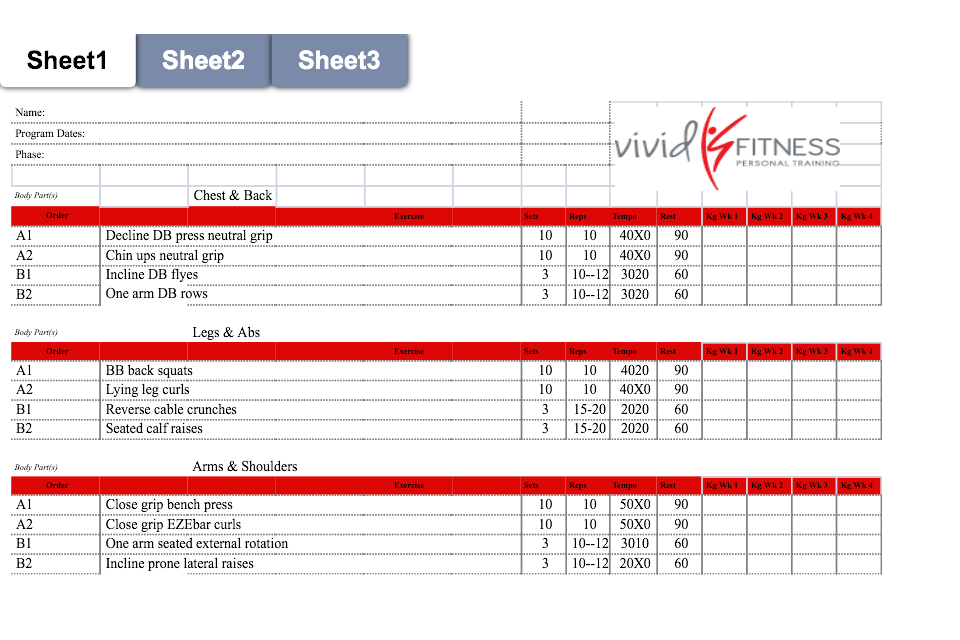
And here is an example week planner for a GVT program...

Day 1 - Chest & Back

Day 2 - Legs & Abs

Day 3 - Rest

Day 4 - Arms & Shoulders

Day 5 - Rest

And a example program....


Have fun!!!


NB. Please check with your Health Care or Exercise Professional before commencing a new exercise program

Tuesday, 8 October 2013

Great outdoors...

I recently wrote a guest blog on the website Muscle Mayhem on the benefits of doing some of your training outdoors. I never shared the blog so here it is...

What is your morning constitution? Do you even have one? Would you like one? Do you even know what the phase “morning constitution” means? It’s a beautiful phrase, one that I have heard many times before from the older generation. A constitution refers to a person’s health and vitality.
 
 
For me, my morning constitution is my gym session. I have no issue spending an hour each morning lifting and it is something I look forward to. For others, an hour in the gym would be a form of torture. Many find it so outrageously boring that they very rarely reach the goals they set out to achieve when they take out a gym membership.

Exercising indoors is a relatively new phenomenon. When you think back to our primal selves, exercise came from hunting and gathering, climbing, digging, throwing and running. Nowadays with the advancement of technology we see so many people walking or running on a treadmill inside the gym which is their form of exercise.

Is this better than getting outdoors for your walk or run? The answer is a definite no. The treadmill fails to activate your glutes and hamstrings in the same way that the outdoor ground will. So this is one benefit for taking your running outside but there are so many more benefits to training in the great outdoors!!
 
 
Vitamin D

Vitamin D is produced by your skin in response to exposure to ultraviolet radiation from natural sunlight. Vitamin D is a nutrient you can obtain for free and it prevents osteoporosis, depression, prostate cancer, breast cancer, and even effects diabetes and obesity. Probably one of my top reasons for getting out of the gym and into the sun!

Endorphins

Who doesn’t love those feel good hormones!!?? And training outdoors has been associated with higher levels of these chemicals which are produced in the pituitary gland and hypothalamus during exercise. Another natural and beneficial chemical that the body produces is Serotonin. Exposure to sunlight helps boost Serotonin levels which in turn helps you feel calm, alert and capable.

 
Clean Air

We all know how air-conditioning is the perfect breeding ground for germs so why not avoid the winter colds that are currently circulating and enjoy the fresh outdoor air. Fresh air is refreshing and invigorating due in large to the rich negative ion content. Negative ions increase the flow of oxygen to the brain and have been linked to an improved sense of well-being, increased alertness, decreased anxiety and a lower resting heart rate.

Burning the calories

Time to bust out of that fitness rut and shock your body by mixing things up with some more challenging terrain. Training outdoors challenges your body to move in more varied and complex ways which in turn will increase your calorific burn.  You may also be pleasantly surprised at how quickly time flies outside of the gym. Changing your routine, seeing new faces, taking in the scenic shrubbery can all help combat exercise boredom and before you know it, you’ve doubled your workout to 60 minutes instead of the normal 30 minute treadmill slog.

Ready to rock

The great outdoors is ready whenever you are! No gym opening or closing times to worry about. No class schedules. No waiting around for a treadmill to become available. When you get outside of your front door, the outdoors is there to greet you with open arms!
 
So what are you waiting for?


Wednesday, 2 October 2013

Proud...

So you remember Ritchie?


Ritchie completed my 12 week transformation back in the middle of the year and since then he has been going from strength to strength, literally! He has a new found enjoyment {I won't say love as that may be going a little too far} for training and he can now see the huge benefits leading a healthy, active lifestyle has.

Not only am I proud of him for his achievements but I am also proud to let everyone know that Ritchie's transformation has been awarded an awesome prize from Complete Supplements Australia. Matt from CSA kindly offered, at the start of the Transformation Challenge, to award a $500 prize package to the Vivid Fitness client who achieved the biggest transformation! Ritchie, with me as his trainer, WON THE PRIZE!! YAY!!

I never posted Ritchie's measurements in my last blog post so here they are...

1/3/13
Chest 109cm
Waist 102cm
Hips   105cm
Bicep 35cm
Thigh 64cm
Weight 93.4kg

31/5/13
Chest 105cm
Waist 90cm
Hips   101cm
Bicep 36cm
Thigh 62cm
Weight 83.9kg

Ritchie, you continue to amaze me with your determination! I love training you. And a big thank you to Matt at CSA for his very kind and generous prize and for believing in all the Vivid Fitness clients that took part in the Transformation Challenge.

I'm looking forward to the next Challenge that will be kicking off at the start of 2014!